If you’ve ever asked “how much does a website cost,” you’ve probably gotten a number with no context behind it. No breakdown. No explanation of what’s included. No mention of what happens in year two when the renewal invoices start landing. You’re left comparing a $2,000 quote against a $12,000 quote with no real way to know if they cover the same thing, because they almost never do.
At Mudpaw Design House, we hear this question from small business owners almost every week. The honest answer: it depends on a lot more than most people expect. The build fee is just the beginning. Hosting, security, maintenance, SEO setup, plugin licenses, these aren’t optional extras. They’re the cost of keeping a website alive and working.
By the end of this website price breakdown, you’ll know realistic one-time build costs across every approach, what you’ll actually spend each year to keep the site running, which hidden costs blindside business owners at launch, and what to ask any vendor before you sign anything.
How much does a website cost? DIY vs. freelancers vs. agencies
These three options don’t just differ in price. They differ in what you’re responsible for, how much of your own time gets consumed, and what you actually end up with. Understanding the full website cost estimate upfront keeps you from comparing numbers that aren’t measuring the same thing.
DIY website builders: the real numbers
DIY platforms cost between $60 and $300 for your first year when you factor in a domain ($15, $20/year) and a paid builder subscription ($15, $60/month). The “free” tier on most platforms means a branded subdomain and ads embedded in your pages. That’s not a business website; it’s a placeholder. For anything that represents your business professionally, you need a paid plan.
The harder cost to account for is time. Building a site on a platform you don’t fully understand, troubleshooting layout issues, wiring up contact forms, and then figuring out how to update it six months later, that’s dozens of hours spent on something that isn’t your actual job. For businesses counting on their site to generate leads or revenue, that’s a real cost with a real ceiling.
Freelancers: where quality meets the middle ground
A freelance project for a basic custom site typically runs $1,000, $4,000 on the lower end, with senior specialists charging $100, $250 per hour. Template-based freelance work often starts around $1,500; truly custom layouts push toward $4,000, $10,000 depending on complexity. Rates on global platforms can look attractive at $25, $50 per hour, but quality and communication vary significantly at that price point, and you usually get what you pay for.
The freelancer model works well when you have a defined scope and the bandwidth to manage the relationship yourself. The gap is post-launch: most freelancers don’t offer ongoing security monitoring, maintenance plans, or SEO support unless you explicitly contract for it.
Agencies: what justifies the higher number
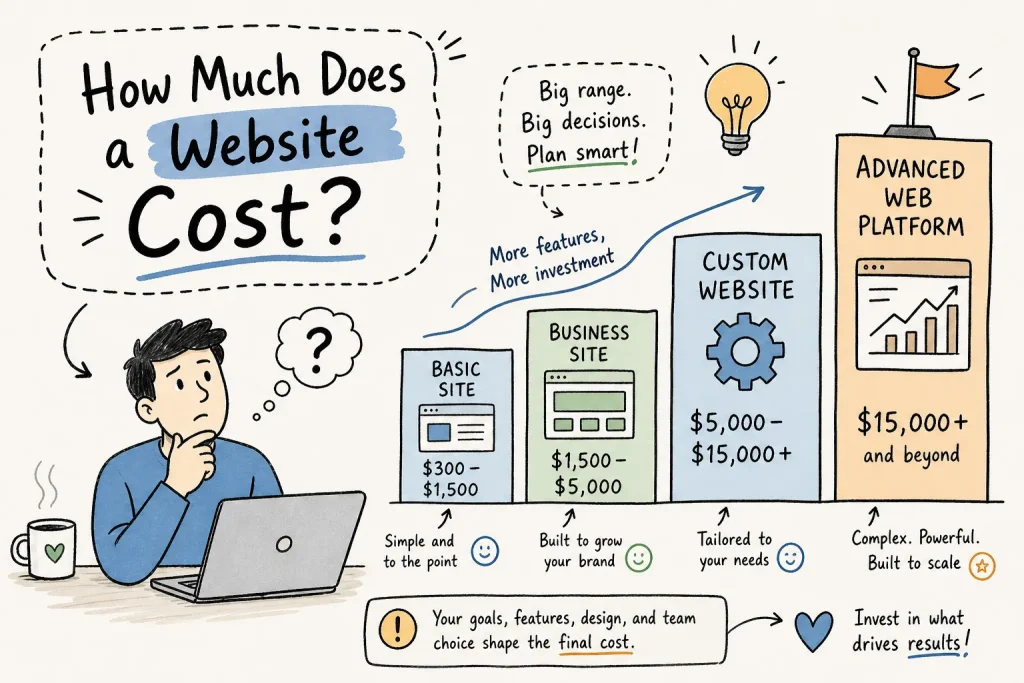
Agency website development cost for a 5, 10 page business site typically starts between $4,000 and $15,000, with many boutique agencies pricing in the $8,000, $15,000 range for fully scoped, strategy-first projects. That price covers strategy, project management, custom design, development, and often an initial SEO setup. The gap between freelancer and agency pricing isn’t padding, it’s the cost of a coordinated team, accountability at each stage, and a process designed to catch problems before launch rather than after.
For businesses where the website is a primary revenue driver, that structure matters. A freelancer building alone has no project manager reviewing their work. An agency does.
What drives your website cost up (or keeps it down)
Two quotes can differ by $10,000 and still be covering the same five-page site. The variables that create that gap are worth understanding before you start requesting proposals.
Custom design vs. a pre-built template
A custom-designed site costs more because every layout decision is made specifically for your business and your audience. Templates are faster and cheaper to deploy, but they often require workarounds that slow the site and limit flexibility over time. The cheapest option now can become the most expensive option two years later when you’re rebuilding from scratch because the template can’t scale with you.
E-commerce and integrations: where costs spike fast
Adding a shopping cart, payment processing, inventory management, and shipping integrations adds $2,000, $25,000 to a build depending on complexity. Hosted platforms absorb much of the infrastructure cost but add $30, $300 per month in platform fees on top of your build cost. Budget roughly 3% of projected revenue for payment processing fees alone, on top of any platform subscription.
How much does a website cost when you add SEO, security, and hosting?
Many quotes exclude hosting, SSL setup, technical SEO configuration, and security monitoring. When these are billed separately, they add $300, $1,800 per year depending on the managed service level. Knowing whether these are included is the single most important thing to clarify before accepting any quote. A $3,000 build that excludes all of these is not cheaper than a $5,000 build that includes them.
Recurring costs that never show up in the initial quote
Year one feels manageable. Year two is where business owners get surprised. Once the build fee fades from memory, the recurring invoices arrive, and most people didn’t plan for them.
What you’ll spend every year just to keep the site running
Domain renewal runs $15, $60 per year. Hosting ranges from $24 to $1,800 per year depending on whether you’re on shared hosting or a managed plan. Premium plugin licenses add another $100, $600 per year for the tools your site depends on. A realistic website maintenance cost for a small business site, if you’re managing it yourself, runs $1,100 to $5,000 annually.
Professional maintenance plans that cover updates, backups, malware scanning, and uptime monitoring add $300, $1,800 per year on top of infrastructure costs. For most small business owners, outsourcing this is worth it, not because the tasks are hard, but because a missed update that opens a security vulnerability costs far more than the maintenance fee itself.
One-time hidden costs at launch
Stock photography, font licenses, and professional copywriting are almost never included in a base quote. Accessibility compliance work, privacy policy tools, and advanced SSL certificates add another $300, $2,000 if they’re not planned upfront. Budget an additional 10, 20% of your total build cost as a contingency for these overlooked items and treat it as a fixed line item, not a maybe. This isn’t pessimism; it’s the pattern across hundreds of real projects.
What “all-inclusive” web design actually means
The phrase gets used loosely. Here’s what it should actually mean, and how to tell whether a package genuinely qualifies.
The à la carte trap that inflates your actual cost
A $3,000 quote can quietly become $6,000 in year one once you add managed hosting, a security plugin, an SEO tool, and a maintenance retainer. Most budget freelance builds and DIY platforms require you to source, pay for, and manage each of those components separately. The real comparison isn’t the sticker price; it’s the total cost to build a website and keep it running at the 12-month mark.
What a bundled package should actually include
A genuinely all-inclusive small business website package bundles technical SEO setup, SSL, hosting, backups, malware scanning, and software updates into one transparent cost. At Mudpaw Design House, that’s how we structure our builds: custom sites where hosting, security monitoring, technical SEO, and backups are rolled into a single predictable package. No surprise invoices, no piecing together third-party tools on your own.
That kind of cost structure doesn’t just save money. It saves the time you’d spend managing five different vendor dashboards, chasing down renewal notices, and diagnosing problems that span two vendors pointing fingers at each other.
How to pick the right build approach for your situation
There’s no single right answer here. The right choice depends on what your site needs to accomplish, not on what’s cheapest upfront.
DIY: when it makes sense
DIY works if you’re validating a new idea with a tight budget and expect to rebuild properly within 12, 18 months. It also works for simple informational pages where lead generation and SEO aren’t priorities. The moment you’re counting on your website to generate calls, form fills, or revenue, DIY becomes a liability, not a savings. A site that looks amateur or loads slowly is actively costing you customers every week it’s live.
Freelancers: the right fit
A freelancer makes sense when you have a clear, defined scope and the bandwidth to manage the relationship yourself. In practice, that typically means a budget in the $2,000, $8,000 range, keep in mind that’s a practical guideline, not a hard market floor, since capable freelancers exist at multiple price points. Vet their portfolio specifically for businesses similar to yours, confirm they cover post-launch support, and get revision limits in writing. For ongoing SEO, security updates, and technical maintenance, you’ll likely need to bring in additional help unless the freelancer explicitly covers it.
Agencies: when the math changes
An agency makes financial sense when your website is a primary revenue driver and you can’t afford downtime, poor search visibility, or slow load times. If you want web design, local SEO, Google Business optimization, and ongoing support without managing multiple contractors, an agency absorbs that coordination cost. The upfront number is higher, but how much it costs to build a website that actually performs, including all the recurring pieces, is often competitive with a DIY or freelance build once year two is factored in.
8 questions to ask any web designer before signing
Use these to clarify exactly what you’re getting and surface any hidden costs before you’re locked in. A vendor who can’t answer these clearly is telling you something important.
- Is hosting included, and what type: shared, managed, or VPS?
- Does the quote cover SSL, security monitoring, and regular backups?
- Is technical SEO setup (sitemaps, schema markup, page speed optimization) included?
- How many revision rounds are covered, and what’s the cost beyond that?
- Who owns the domain and site files at the end of the project?
- What does ongoing maintenance cost after launch?
- Are premium plugin or theme licenses included or billed separately?
- What’s the timeline, and what happens if the project runs over?
Watch for these red flags in any proposal: no mention of hosting, SSL, or maintenance; a very low fixed price with no scope document attached; and no clarity on who handles post-launch bug fixes or software updates. Any one of these signals a quote built to win the job, not to serve you after the project closes.
How much does a website cost in 2026? The number that actually matters
The real cost of a website in 2026 isn’t just the build fee. It’s everything that keeps the site ranking, loading, and converting after launch. To recap the ranges: DIY runs $60, $300 upfront; a freelancer build typically runs $1,500, $10,000 depending on scope and experience level; a full-service agency build commonly runs $4,000, $15,000 or more. On top of any of those approaches, plan for annual recurring costs of $1,100, $5,000 to keep the site running properly.
The smartest way to answer “what’s this going to cost me” is to ask what’s actually included, not just what the number is. Two quotes are only comparable when they’re covering the same ground. Most aren’t.
If you want a straight answer on what a professionally built, fully managed small business website costs, get a quote from Mudpaw Design House. We’ll give you the full breakdown upfront, what’s included, what it costs, and what you’ll pay to keep it running, before you commit to anything.